Why cultural strategies are essential to growing our regions
// creative industries // Creative UK // culture

I’m Juris Cace, co-founder and Operations Director at Screendm, alongside my co-founder, Juris Tomsons, we are building a digital home for creative students. It is a platform where they can find like-minded people beyond their own discipline and university walls, collaborate on projects, showcase their work, and get discovered by industry before they graduate.
We are at the exciting stage of validating our MVP. The platform is built so students can create verified portfolios, collaborate across universities and explore each other’s work and we’re growing a waitlist of students across the UK ahead of our launch. Our main focus at the moment is to find university partners to pilot with us, working with their careers services and academic staff to test Screendm with real cohorts and make sure that it genuinely serves students. Joining Creative UK is a big part of that, helping us connect with students, universities and industry so we are building the right thing for the people who will actually use it.
Honestly, we are cautious calling anything our proudest achievement just yet. Getting Screendm this far has had its challenges and, I guess, we are proud that we kept on going and built something real students respond to. But the milestones that would really make us want to celebrate are still ahead of us. For now we are keeping our heads down and focusing on whats next.
I come from a small town in Latvia and always wanted to explore different cultures and see the world through other people’s eyes and cultures. When I arrived in the UK I loved meeting so many different people and that experience shaped how I think about creativity and its partly why equity, diversity and inclusion is one of the foundations of what we are building.
For us EDI isn’t a separate initiative, it’s one of the reasons Screendm exists. Creative opportunity in the UK is still heavily concentrated in a small number of places and it isnt spread evenly. Talent is everywhere, but the chances to build a creative career are heavily concentrated in London and the South East. We are working to change that in a few practical ways. First, Screendm is always free for students. Second, the platform is built to surface work from any university, not just a handful of well known institutions. Third, we are cross-discipline and cross-university by design so students can collaborate beyond their own course. That helps to break down the closed networks that so often keeps the opportunity just for the few.
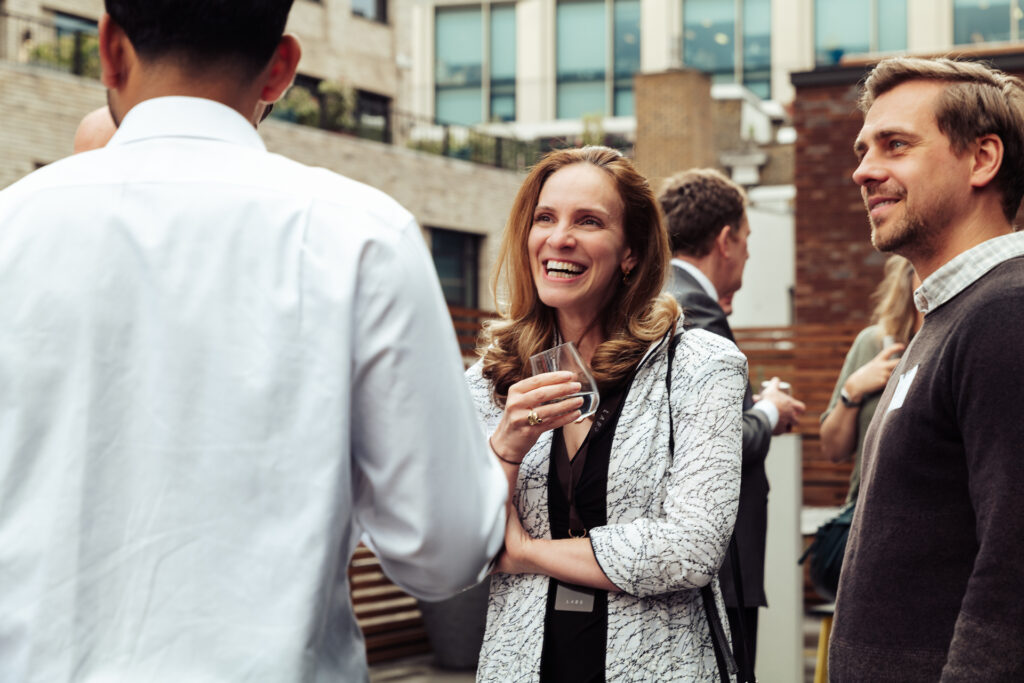
Juris pictured next to Creative UK’s Chief Executive, Emily Cloke, at a Creative UK Connects networking event in London.
1. The sheer quality of work coming from students. This is the part of the job I love the most. The work students are making right now is genuinely incredible. Projects that take almost a year to make with little to no funding in film, fashion, gaming and so on, that hold their own against anything coming out of the professional world. Every time we look at what’s being created across UK courses, we are reminded why we started Screendm in the first place. There is so much talent and so much of it is still hidden.
2. Creativity spreading well beyond London. For a long time the industry felt heavily based around London and if you studied or lived anywhere else it could feel that the opportunities were happening where you weren’t. That is genuinely starting to shift. More than half of UK games companies are now based outside London and there is real investment going in to creative clusters in places like – Leeds, Manchester, Bristol, Glasgow and so on.
3. Creativity being recognised as something worth investing in. After years of the arts feeling like an afterthought, it’s genuinely refreshing to see the creative industries treated seriously, both culturally and economically. The government’s Creative Industries Sector Plan is backing the sector to grow significantly over the next decade, with hundreds of thousands of new jobs projected. For students choosing a creative path, that change in attitude matters enormously. It’s the difference between feeling like your ambitions are indulgent and feeling like they’re valued.
1. The widening gap between creative education and a real career. This is the one that sits with me most. Young people are committing years of study, and a lot of debt, to pursue creative careers, and then stepping into a landscape where actually making a living is harder than ever. Fewer than half of creative graduates are in full-time work within 15 months of finishing, and many end up piecing together freelance and part-time work to get by. It doesn’t feel fair to ask people to invest so much in their talent and then leave them to figure out the route into industry on their own. That gap between education and earning a living is exactly what keeps us as an organisation motivated.
2. The obsession with following over substance. So much of the creative world now runs on follower counts and going viral. A genuinely brilliant piece of work can get buried while something forgettable takes off because it played the algorithm well. It’s a shame to watch talented students feel they have to become marketers and content machines just to get noticed, rather than being able to let the work speak for itself.
3. How fast we’re moving with AI before we’ve understood the long term implications. AI is advancing so quickly that the creative world feels like it’s rushing in before anyone has stopped to ask what it means for the people at the heart of it. The creative industries contribute around £124bn a year to the UK economy, built entirely on human skill, imagination and years of craft. Yet much of that work is being used to train AI models with little transparency and no compensation for the people who made it. What worries me most is what this means for students and emerging creatives. They’re being asked to build careers on their originality and craft at the exact moment the value of human-made work is being called into question. I’m not anti-technology at all, but I’d love to see more care taken over how this plays out, so the next generation of creatives is protected rather than left to deal with the consequences later.
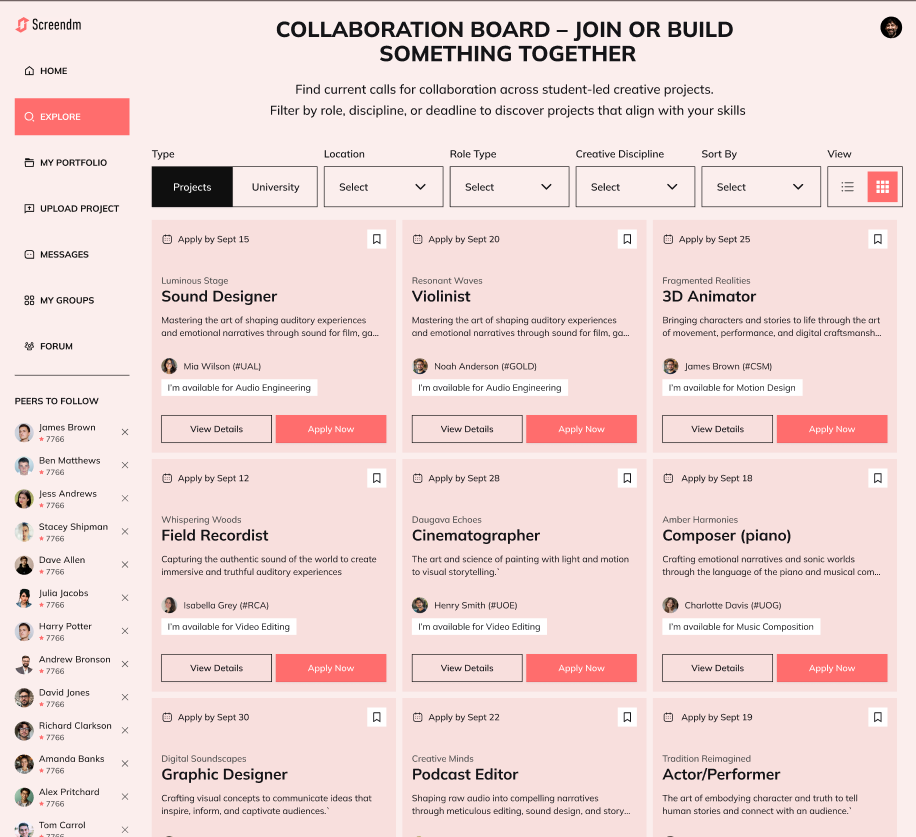
Illustrative example of the user interface on the Screendm platform.
Our dream collaborators are the universities themselves. The institutions producing this incredible creative talent are the people we’d most love to build alongside, partnering with their courses, careers services and academic staff so students get seen from day one rather than after they graduate. If we could pick a few forward-thinking universities across different disciplines and regions to pilot with us and shape where this goes, that would be the dream.
For me, creativity is how we make sense of the world and share something of ourselves with it. It’s not just talent or technical skill, it’s a way of seeing, of taking what’s in your head and your heart and turning it into something other people can feel and relate to. And I love that creativity isn’t limited to one discipline or one type of person. A filmmaker, a fashion designer, a games developer and a journalist are all doing the same fundamental thing; expressing something only they could. That belief is really the foundation of everything we’re building. Every student has something worth sharing, and creativity is what happens when they’re given the space, and the audience, to share it.
What excites me most about what’s next isn’t a single milestone, it’s the world we’re trying to build. We want Screendm to become a genuinely connected creative ecosystem, somewhere a student’s work is seen, valued and actually used to open doors, whatever their discipline, wherever they study, and whatever their background. A place where talent finds talent across courses and borders, and where the wall between education and industry slowly starts to come down.
The honest challenge in front of us is doing that without losing what makes it worth building. A community like this only really works if it earns trust before it chases scale, and the easy thing would be to go after numbers. We’d rather grow carefully and keep it authentic, making sure the students who most need to be seen, not just the already well-connected ones, are the people who actually benefit. Getting that balance right, between moving fast enough to be useful and staying true to who we’re building for, is the question we’ll be wrestling with most. And it’s a good problem to have, because it means people care.
The biggest thing I’d love to see change is how open the industry is to new talent. For all its brilliance, the creative world can still be hard to break into, and opportunity often flows through established networks, places and institutions. None of that is anyone’s fault exactly, it’s just how the system has developed over time. But it means a lot of genuinely talented people struggle to find a way in, simply because they don’t start with the right connections.