Members Spotlight: Living Wage Foundation
// Member News // Members Spotlight
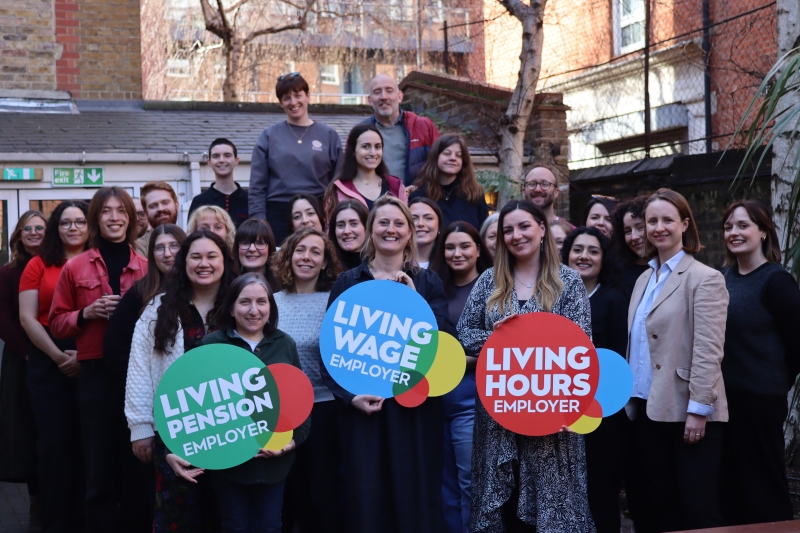

I’m Lianna. I’m a Partnerships and Campaigns Manager, and I lead the Living Wage Foundation’s work to tackle low pay in the creative and cultural (C&C) sector. At the moment, we have over 1,700 + accredited Living Wage employers in the C&C world. What they have in common is a commitment to ensuring that their staff, as well as outsourced workers like cleaners, are paid enough to meet the real costs of living. I also manage the Living Wage Funders scheme, which brings together more than 90 funders who are committed to supporting their grantees to pay the real Living Wage.
I’m planning our annual London Living Wage Week event. Every year, we bring together champions within our Living Wage network to celebrate the Living Wage movement, and to welcome new Living Wage employers. This will be a particularly special one, as we will be marking the 25th anniversary of the Living Wage Foundation! Last year, we held the event at London Stadium and the brilliant schoolchildren of St Anthonys performed a song about the real Living Wage, there wasn’t a dry eye in the house. Colleagues are organising Living Wage Week events in Manchester, Sunderland and Birmingham too – last year, Andy Burnham gave a riproaring speech at our Manchester event, he’s been a fantastic advocate over the years for the real Living Wage.
Putting over £4.1bn into the pockets of low paid workers. The Living Wage movement started in a community hall in East London with a group of low-paid workers, largely from racialised backgrounds. So it’s incredible that 25 years on from that, we are now a network of over 16,000 employers, including over half of FTSE 100 companies, and major employers including Channel 4, Tate, the Royal Albert Hall and Arts Council England. Behind the big numbers are hundreds of thousands of people who sleep that bit better at night, who are able to get new shoes when their kids need them or pay for a repair if the washing machine breaks. There’s still a long way to go – 4.4 million workers in the UK are still paid less than the real Living Wage – but things are going in the right direction – but things are going in the right direction.
We’ve focused on highlighting the racial and gender disparities in low pay. 17% of people from racialised backgrounds are paid below the real Living Wage, compared to 13% of all workers. And jobs held by women account for over half (59%) of all low paid jobs. It’s stark and visible in many cultural organisations: you can literally see that C-suite workers are disproportionately white, whilst those cleaning the offices at the end of the day are disproportionately women, often women of colour. Paying the real Living Wage is, in my opinion, one of the most important actions that employers can take to tackle their ethnicity pay gap and gender pay gap.
Increasingly, we are seeing C&C employers recognise the importance of Living Wage in improving socio-economic diversity too. It’s not rocket science. If you come from a low-income background and you don’t have savings or family support, you’re going to struggle to say yes to an entry-level job that pays less than the real Living Wage, especially if it requires moving to a new city. The TV Foundation have been doing sterling work to increase the number of working-class people in TV. I was delighted to see recently that they’ve included paying the real Living Wage in their list of actions that employers must take to become a Class Confident organisation.
I would love DCMS to become a Living Wage employer, and work with us to embed the real Living Wage throughout the culture sector. Department for Business and Trade (DBT) became a Living Wage employer earlier this year, the first Government department to accredit, so I’m optimistic.
Expression from your own unique, human perspective.
One exciting project is growing our network of Living Hours and Living Pensions employers. Many of our Living Wage employers now want to take the next step, and ensure that their workers have secure working hours, and a decent income when they retire. On 6th October, we held an online information session about Living Hours and Living Pensions. These informal webinars are a fairly new development for us, but they’ve been a brilliant way to platform some of the employers in our network who are going above and beyond, and open a space for people to find out more about the practicalities of the scheme.
In one word – pay. We need to make sure that every person in our sector is paid enough to cover the real costs of living – and that needs to include people like cleaners, who may not do creative jobs themselves, but are absolutely vital to keeping the industry going. Nearly one in three jobs in the arts is paid below the real Living Wage, making it one of the worst-paid sectors in the UK. Progress is happening, and huge credit is due to culture funders, arts leaders and union members who persistently insist on decent pay for all workers, not just directly employed staff.